Introduction
Threaded inserts — often called insert nuts, threaded bushings, or embedded nuts — are small but critical components in modern manufacturing. Whether you are designing a consumer electronic device, an automotive component, or a medical instrument, choosing the right insert nut can make the difference between a durable, reliable product and one that fails in the field.
But with so many options available — different materials, profiles, thread standards, and installation methods — how do you make the right choice?
This guide walks you through everything you need to know to select the optimal insert nut for your plastic assembly.
Step 1: Understand Your Application Requirements
Before diving into specifications, answer these fundamental questions:
| Question | Why It Matters |
|---|---|
| What is the base material? | Determines installation method and insert profile |
| What is the operating environment? | Dictates material choice (brass vs stainless steel) |
| What loads will the insert bear? | Determines insert size, depth, and knurl type |
| Will the screw be removed repeatedly? | Influences thread durability requirements |
| What is the production volume? | Affects installation method selection and cost |
| Any regulatory requirements? | RoHS, REACH, FDA, or other compliance needs |
Step 2: Choose the Right Material
The two most common materials for insert nuts are brass and stainless steel. Each has distinct advantages.
Brass Insert Nuts (C3604 / H59)
Brass is the industry workhorse for threaded inserts. It offers an excellent balance of machinability, corrosion resistance, and cost-effectiveness.
| Pros | Cons |
|---|---|
| Excellent machinability — tight threads, smooth finish | Lower tensile strength than steel |
| Good corrosion resistance in normal environments | Not suitable for high-temperature applications |
| Cost-effective for medium to high volumes | Can tarnish over time without plating |
| Good thermal conductivity — helps during heat staking | Not ideal for marine or chemical environments |
Best for: Consumer electronics, general plastic enclosures, indoor applications, cost-sensitive projects.
Stainless Steel Insert Nuts (SUS303 / SUS304 / SUS316L)
Stainless steel inserts are the premium choice for demanding environments.
| Pros | Cons |
|---|---|
| Superior corrosion and chemical resistance | Higher material cost |
| High tensile and shear strength | More difficult to machine — slightly looser tolerances |
| Excellent high-temperature performance | Heavier than brass |
| Ideal for outdoor, marine, and medical applications | May require passivation for optimal corrosion resistance |
Best for: Automotive under-hood components, outdoor equipment, medical devices, food processing machinery, marine applications.
Quick Rule: If your product lives indoors and cost is a concern → brass. If it faces moisture, chemicals, heat, or high mechanical stress → stainless steel.
Step 3: Select the Insert Profile
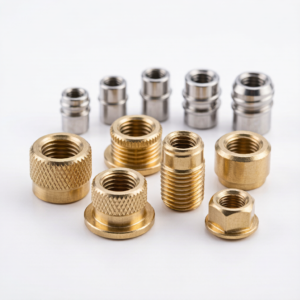
The outer profile of the insert determines how well it grips the surrounding plastic. Here are the most common types:
Straight Knurl
- Most common profile
- Good all-around torque and pull-out resistance
- Suitable for heat staking and ultrasonic insertion
- Cost-effective and widely available
Diamond Knurl
- Cross-hatched pattern provides multi-directional grip
- Higher torque resistance than straight knurl
- Preferred for applications with rotational loads
- Slightly more expensive to manufacture
Hexagonal Profile
- Six flat sides provide maximum torque resistance
- Often used in insert molding applications
- Prevents rotation even under high torsional loads
- Requires matching mold geometry
Flanged Head
- Integrated collar/flange sits flush against the surface
- Prevents the insert from sinking below the mounting plane
- Provides a clean, finished appearance
- Distributes load across a larger surface area
| Profile | Torque Resistance | Pull-Out Strength | Best Installation Method |
|---|---|---|---|
| Straight Knurl | ★★★☆☆ | ★★★★☆ | Heat Staking, Ultrasonic |
| Diamond Knurl | ★★★★☆ | ★★★★☆ | Heat Staking, Ultrasonic |
| Hexagonal | ★★★★★ | ★★★☆☆ | Insert Molding |
| Flanged + Knurl | ★★★★☆ | ★★★★★ | Heat Staking, Ultrasonic |
Step 4: Decide — Blind-Hole or Through-Hole?
Blind-Hole (Closed-End) Inserts
- One end is closed — the screw cannot pass through
- Provides a clean, sealed appearance from the outside
- Prevents dust, moisture, and debris from entering the assembly
- Limited screw depth — must match screw length to insert depth
Best for: Visible exterior surfaces, sealed enclosures, applications requiring a clean cosmetic finish.
Through-Hole (Open-End) Inserts
- Both ends are open — the screw can pass completely through
- No restriction on screw length
- Ideal for multi-layer stacking and clamping applications
- Does not provide sealing
Best for: PCB stacking, multi-component clamping, adjustable mounts, applications where screw length may vary.
Step 5: Match the Installation Method
Your choice of installation method affects both the insert design and your production process.
| Method | How It Works | Pros | Cons | Best For |
|---|---|---|---|---|
| Heat Staking | Insert is heated and pressed into a pre-molded hole; plastic melts and flows around the knurl | Low equipment cost, simple process | Slower cycle time, operator-dependent | Low to medium volumes, prototyping |
| Ultrasonic Insertion | Ultrasonic vibrations melt plastic around the insert as it is pressed in | Fast, consistent, automated | Higher equipment cost | Medium to high volumes |
| Insert Molding | Insert is placed in the mold before plastic injection; becomes fully encapsulated | Strongest bond, no secondary step | Higher mold cost and complexity | High volumes, critical applications |
| Cold Pressing | Insert is mechanically pressed into an undersized hole | No heat, simple, fast | Lower pull-out strength, stress on plastic | Soft thermoplastics, simple assemblies |
Pro Tip: If you are starting with low volumes and plan to scale, consider designing your hole geometry to accommodate both heat staking and ultrasonic insertion — this gives you flexibility as volumes grow.
Step 6: Specify Thread and Dimensions
Thread Standard
- Metric (ISO): M2, M2.5, M3, M4, M5, M6, M8 — most common globally
- UNC/UNF (Imperial): 2-56, 4-40, 6-32, 8-32 — common in North America
- Custom Threads: Available for specialized applications
Key Dimensions to Specify
| Dimension | Description |
|---|---|
| OD (Outer Diameter) | The external diameter of the insert body |
| Length | Overall length of the insert |
| Thread Size | Internal thread specification |
| Flange Diameter | Diameter of the flange (if applicable) |
| Knurl Pitch | Spacing of the knurl pattern |
| Pilot Diameter | Reduced-diameter tip for easy alignment (optional) |
Step 7: Don’t Forget Surface Treatment
Surface treatment affects corrosion resistance, appearance, and — for SMT nuts — solderability.
| Treatment | Material | Benefits |
|---|---|---|
| Natural / Bare | Brass, Stainless Steel | Cost-effective, no added process |
| Nickel Plating | Brass, Steel | Enhanced corrosion resistance, bright finish |
| Tin Plating | Brass, Steel | Excellent solderability (SMT nuts) |
| Zinc Plating | Steel | Good corrosion protection, economical |
| Passivation | Stainless Steel | Removes free iron, maximizes natural corrosion resistance |
| Black Oxide | Steel | Mild corrosion protection, matte black appearance |
Quick Decision Matrix
| If You Need… | Choose… |
|---|---|
| General-purpose plastic fastening | Brass, straight knurl, heat stake |
| High-strength, harsh environment | Stainless steel, diamond knurl |
| Clean cosmetic surface | Brass, flanged, blind-hole |
| Maximum bond strength | Insert molding, hexagonal or knurled |
| PCB assembly | SMT nut, tin-plated, tape & reel |
| Multi-layer clamping | Through-hole, straight knurl |
| Marine or outdoor use | SUS316L, passivated |
| Low-cost prototyping | Brass, straight knurl, heat stake |
Common Mistakes to Avoid
- Mismatched hole size: Too large = weak grip. Too small = cracked plastic. Always follow the insert manufacturer’s recommended hole diameter and tolerance.
- Wrong installation temperature: Overheating during heat staking degrades the surrounding plastic. Underheating results in poor melt flow and weak bonding.
- Ignoring screw engagement length: The screw should engage at least 1.5× the thread diameter for optimal strength. For example, an M3 screw should engage at least 4.5 mm of thread.
- Skipping material compatibility: Some plastics (like POM or PP) are difficult to bond with inserts. Consult your insert supplier if you are working with challenging materials.
- No prototype testing: Always test insert performance in your actual plastic material and wall thickness before committing to production tooling.
Why Partner with XinLianHao Hardware?
At Dongguan XinLianHao Precision Hardware Co., Ltd., we manufacture a full range of insert nuts — from standard catalog items to fully custom solutions. Here is what sets us apart:
- Expert Guidance: Not sure which insert is right for your application? We help you choose — based on your material, process, and performance requirements.
- Custom Manufacturing: Send us your drawing or sample, and we produce to your exact specifications.
- Quality Consistency: Tight tolerances, clean threads, and consistent surface finish — batch after batch.
- Competitive Pricing: Dongguan manufacturing efficiency, delivered globally.
- Fast Turnaround: Samples in days, production in weeks.
Contact us today for a free consultation and quotation.
📧 dgjmart@163.com | 📞 +86 138-2326-5011